
Hand rankings from strongest to weakest
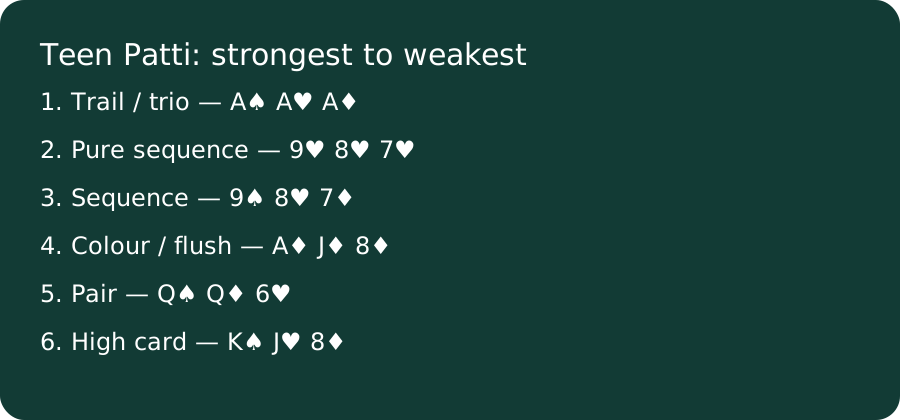
| Order | Example | How to recognise it |
|---|---|---|
| 1. Trail / trio | A♠ A♥ A♦ | 3 equal ranks |
| 2. Pure sequence | 9♥ 8♥ 7♥ | 3 consecutive ranks, 1 suit |
| 3. Sequence | 9♠ 8♥ 7♦ | 3 consecutive ranks, mixed suits |
| 4. Colour / flush | A♦ J♦ 8♦ | 1 suit, without a sequence |
| 5. Pair | Q♠ Q♦ 6♥ | 2 equal ranks + 1 kicker |
| 6. High card | K♠ J♥ 8♦ | Compare cards highest to lowest |
The category wins before individual card values are compared. A low sequence beats a high colour. A colour beats a pair, even if the pair contains aces. Within a category, compare the ranks using the rule agreed for that table.
Three comparisons beginners often miss
| Comparison | Result | Reason |
|---|---|---|
| 4♠ 3♥ 2♦ vs A♣ K♣ J♣ | 4-3-2 wins | Sequence outranks colour |
| 9♠ 9♥ 2♦ vs 8♣ 8♦ A♠ | 9-9-2 wins | Pair rank comes before kicker |
| Q♠ Q♥ A♦ vs Q♣ Q♦ K♠ | Q-Q-A wins | Same pair; ace kicker beats king |
For colours and high-card hands, sort the cards by rank. Compare the highest first, then the next and then the last if needed. For example, A-J-8 beats A-10-9 because the second comparison is J against 10. Suits are not given an arbitrary strength order in these examples.
Agree ace sequences and tie rules first
Some rule sets place A-2-3 above A-K-Q; others reverse that order. This guide does not assume a single ordering for every app. State the table’s rule before comparing those two runs. K-A-2 is not a conventional sequence.
Also establish what happens to fully equal hands, when a show is allowed and how sideshow requests work. A rule that applies to a home table may differ from a named app’s variant. The variation guide shows how to document those changes.
A simple practice-round flow
- Shuffle 52 cards and deal 3 to each practice position.
- Classify each hand into 1 of the 6 categories.
- Rank the categories before comparing individual cards.
- Resolve matching categories with the agreed rank and tie rules.
- Award a paper point for each correct explanation and reshuffle.
Traditional play includes terms such as blind, seen, pack and show. The game guide explains those terms without requiring a money stake.
How rare are the categories?
| Category | 3-card combinations | Probability |
|---|---|---|
| Trail | 52 | 0.2353% |
| Pure sequence | 48 | 0.2172% |
| Sequence | 720 | 3.2579% |
| Colour excluding pure sequences | 1,096 | 4.9593% |
| Pair | 3,744 | 16.9412% |
| High card | 16,440 | 74.3891% |
These figures are exact counts from 52 choose 3 = 22,100 unordered hands, assuming 12 accepted rank runs (including A-2-3 and A-K-Q), 4 suits and no jokers. The counts sum to 22,100. Rarity does not change the agreed ranking: trail ranks above pure sequence in the standard order used here even though pure sequence is rarer.
This is a single-hand distribution, not a win probability against opponents. Other players’ cards, variant rules and the number of remaining hands change a comparison problem.
Check your understanding
Try a hand comparison
Which hand is stronger: A♣ K♣ J♣ or 4♠ 3♥ 2♦?
Think category first, then individual cards.
Once the comparisons feel familiar, use a short practice journal to measure accuracy across 10 examples.
App details and evidence record
| Record field | Value / parameter | Evidence scope |
|---|---|---|
| Guide reference | Teen Patti rules & hand rankings | Editorial topic; app identity requires a release record |
| Probability model | 22,100 possible unordered 3-card hands | Declared method or parameters explained on this page |
| Edition date | 26 October 2026 | Editorial revision; distinct from an APK release date |
| Page coverage | 6 sections · 4 questions | Visible guidance in this edition |
| APK test coverage | 0 binaries · 0 installed-app sessions | Supplied website archive and this edition |
| Source references | 0 primary-source links | Listed in the reference section below |
Actual APK version, size, minimum Android API and scan results require the publisher’s binary and release record. Rule calculations and example inputs are not product specifications.
Questions answered
Does a sequence beat a colour?
Yes, in the six-category order used here. For example, mixed-suit 4-3-2 beats a same-suit A-K-J.
Which is higher, A-2-3 or A-K-Q?
That order varies by table or app. Check the house rule before playing; both are accepted runs in the probability model on this page.
Does the highest card always win?
Compare the category first. Within the same category, use the category’s rank comparison and tie rules.
What is the chance of a trail?
There are 52 trails out of 22,100 unordered three-card hands, or about 0.2353%, using a standard 52-card deck without jokers.
Sources & method
Examples and calculations are produced for this guide. Rule assumptions, sample inputs and methods are stated in the relevant section.
Edition prepared with AI assistance. Source links support general guidance; they do not attest to a particular APK. Read our evidence and correction policy.